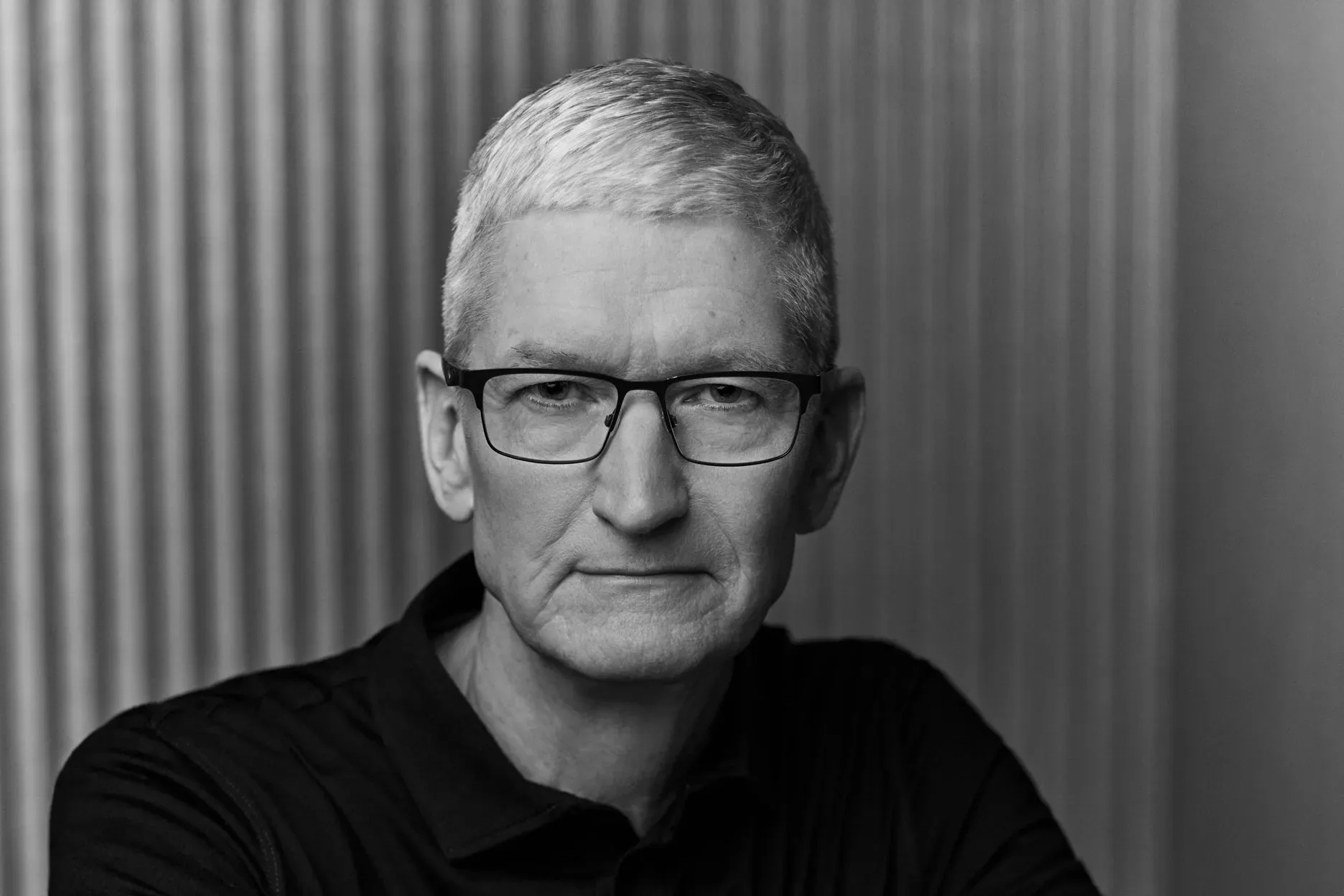
Tim Cook steps down as Apple CEO after 15-year run that reshaped the company
Tim Cook officially stepped down as Apple's CEO after 15 years, handing the role to hardware chief John Ternus, capping a tenure in which Apple's market value grew roughly tenfold and its stock returned nearly 2,000 percent.
Photo: Wired.com
Tim Cook officially ended his tenure as Apple's Chief Executive Officer on 1 September, handing the role to John Ternus, the company's longtime head of hardware engineering, in a transition first announced in April.
Cook, 65, took over as CEO in August 2011, succeeding Apple co-founder Steve Jobs, who died just weeks after formally stepping aside. He inherited a company already highly regarded but still closely tied to Jobs' personal legacy, along with a supply chain widely viewed as one of Apple's operational weak points at the time. Cook, who had joined Apple in 1998 after roles at IBM, Intelligent Electronics and Compaq, spent his early years restructuring Apple's manufacturing and logistics operations into what became one of the company's core competitive strengths.
Under his leadership, Apple's market capitalization grew from roughly USD 350 billion at the time of his appointment to more than USD 4 trillion by the time of his departure, briefly touching USD 5 trillion in the months surrounding his exit. Apple became the first company in history to reach USD 1 trillion in market value in August 2018, doubled to USD 2 trillion by August 2020, neared USD 3 trillion in January 2022, and crossed USD 4 trillion in October 2025.
Apple's share price, adjusted for two stock splits carried out during Cook's tenure, rose from around USD 13 to over USD 300, a gain of roughly 2,000 percent. Over the same period, the S&P 500 returned approximately 500 percent, meaning Apple's stock outperformed the broader market by a wide margin throughout Cook's time as CEO.
Revenue growth followed a similar trajectory. Apple's annual revenue stood at USD 108 billion in fiscal 2011, the year Cook took over, and reached USD 416 billion in fiscal 2025. iPhone revenue alone grew from USD 47 billion to over USD 54 billion in a single recent quarter, while Apple's Services division, largely built out under Cook, expanded from USD 9.4 billion in annual revenue in 2011 to roughly USD 109 billion in fiscal 2025.
Cook's tenure was not without criticism. Some observers argued that Apple's pace of headline product innovation slowed relative to the Jobs era, with the company's push into generative AI seen as a comparatively late and cautious response to competitors. Apple Intelligence, its AI initiative launched in 2024, faced a slower rollout and scaled back features, with an overhauled AI powered Siri yet to fully materialize by the time of Cook's departure.
Even so, in a letter marking his transition, Cook reflected warmly on his time leading the company, describing it as the greatest privilege of his career and pointing to the trust placed in him to lead what he called an extraordinary company.
Ternus, 50, a 25-year Apple veteran, becomes the company's eighth CEO. Cook will remain with Apple as executive chairman, while Arthur Levinson, Apple's longtime non-executive chairman, moves into the role of lead independent director.